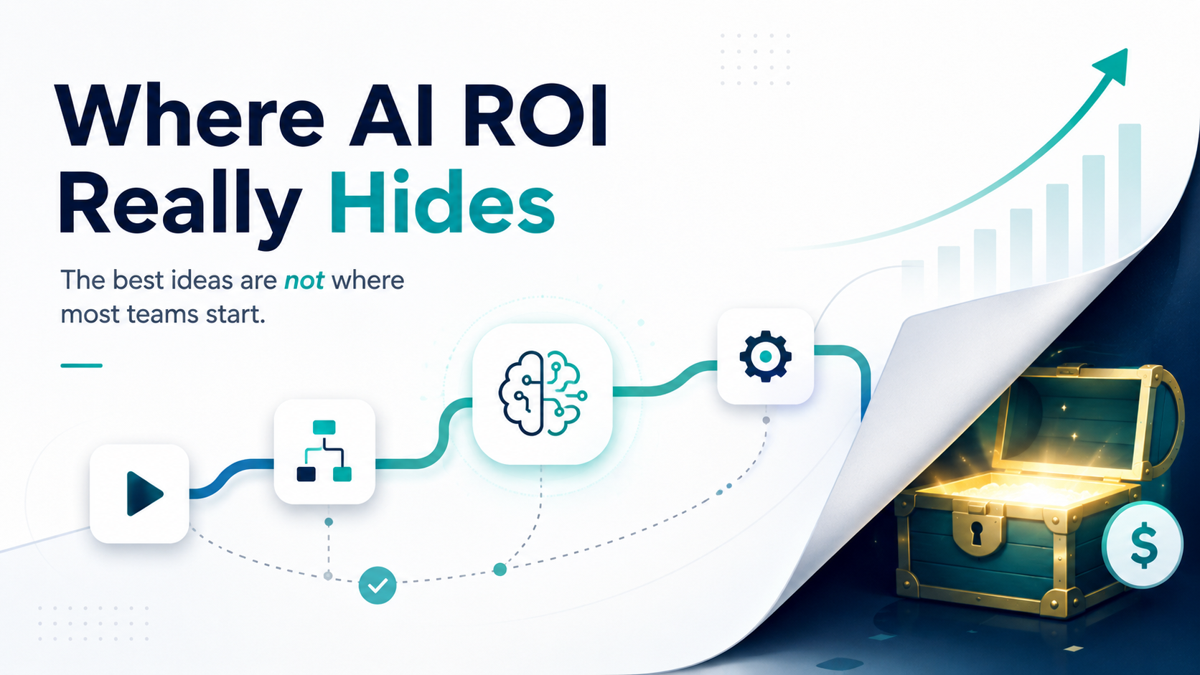
 Do You Know the 3 AI Projects With the Highest ROI?
Do You Know the 3 AI Projects With the Highest ROI?
Most companies do not need a huge AI transformation program to find value. They need one painful workflow that is slow, repetitive, and easy to measure.
That is the part people often miss. The best AI projects are not always the most impressive demos. They are usually the workflows that already cost the business time every week: documents, emails, support requests, leads, forms, approvals, and follow-ups.
That is also why n8n is an excellent place to build them. AI can handle the messy language-heavy step, but n8n can still control the trigger, validation, approvals, API calls, retries, logging, and final system update.
The result is more useful than a standalone chatbot. It is AI connected to an operational process.
TL;DR
- High-ROI AI projects usually start from measurable workflow pain, not from a model choice.
- For small and medium businesses, the strongest first candidates are document intake, lead follow-up, and support triage.
- n8n is a strong fit because it can connect AI output to real systems while keeping validation, review, and auditability in the flow.
- This article is the starting point. The next articles will build each project in n8n with dummy data, then show where real business systems connect.
The pattern behind high-ROI AI projects
No list can guarantee ROI for every company, but the pattern is surprisingly consistent. AI works best when it sits close to a workflow that is already important to the business.
A useful AI project usually has three traits:
- The input is messy: emails, PDFs, notes, transcripts, forms, or free-text requests.
- The output needs structure: a category, summary, score, next action, or JSON record.
- The business impact is measurable: time saved, faster response, fewer missed items, or better prioritization.
That is why these projects are interesting. They do not ask AI to “run the business.” They ask AI to handle a narrow decision or extraction step inside a controlled workflow.
A simple n8n architecture looks like this:

1. AI document and data-entry automation
This is probably the strongest first project for many businesses because it attacks a very common operational cost: people manually reading documents and retyping information into systems.
Invoices arrive as PDFs. Vendor quotes arrive by email. Intake forms use inconsistent wording. Someone still has to read the input, copy the important fields, check for missing information, and update another system.

How the n8n build will work
- Trigger from an email inbox, uploaded file, webhook, or watched folder.
- Use AI to extract strict JSON, such as vendor, invoice number, total, due date, currency, and notes.
- Validate required fields, detect duplicates, and send low-confidence items to human review.
- Write approved records into a spreadsheet, CRM, ERP, or database.
The reveal: The ROI is not from “AI reading PDFs.” The ROI is from turning unstructured documents into structured records the business can actually use.
2. AI lead follow-up and qualification
This project is powerful because the upside is closer to revenue.
A lead fills out a form. Someone should review it, understand the request, decide whether it is urgent, draft a response, update the CRM, and notify the right person. In many small businesses, that process depends on someone noticing the message at the right time.

How the n8n build will work
- Trigger from a website form, email, CRM event, or webhook.
- Use AI to summarize the request, classify intent, and score fit based on simple rules.
- Create a suggested follow-up message for review.
- Update the CRM, notify the owner, and log the next action.
The reveal: The ROI is not from AI writing a fancy message. The ROI is from faster follow-up and fewer valuable leads falling through the cracks.
3. AI support and ticket triage
Support automation is often treated as a chatbot project. That is not the safest first version.
A better starting point is triage. Before AI answers customers directly, it can classify requests, summarize context, route tickets, and draft suggested replies for a human to approve.

How the n8n build will work
- Trigger from a new ticket, email, form submission, or chat transcript.
- Use AI to classify intent, urgency, sentiment, product area, and requested action.
- Route based on business rules, not only AI output.
- Escalate payment issues, sensitive requests, complaints, and low-confidence classifications.
The reveal: The ROI is not the chatbot itself. The ROI is faster sorting, cleaner summaries, better routing, and less repetitive support work.
The guardrail that makes these projects safer
The first version of each workflow should not be fully autonomous. It should assist, route, draft, validate, and prepare the next step. The workflow can become more automated only after the outputs are measured and reviewed.
That means each build should include a few operational controls from the beginning:
- Strict JSON outputs where structured data is required.
- Confidence checks and human review paths for uncertain results.
- Duplicate detection before creating records or sending messages.
- Execution logs, error alerts, and retry handling.
- Clear rules for what AI is allowed to decide and what must stay with a person.
What comes next
This article is only the starting point. The real test is not whether the ideas sound useful. The real test is whether they can be built into workflows that are clear, measurable, and reliable enough to improve.
That is what the next articles will do. I will build these three projects in n8n using dummy data first, so the logic is easy to understand before connecting real systems.
- Building an AI document intake workflow in n8n.
- Building an AI lead follow-up workflow in n8n.
- Building an AI support triage workflow in n8n.
After those builds are published, this article can become the hub page. Each project section can link to the hands-on tutorial, and the series can grow into a practical AI automation portfolio for 2BInformed.
The point is simple: AI ROI is easier to find when the project starts with a workflow, not with a demo.
Suggested internal links
- n8n for Small and Medium Businesses: A Practical Guide to Integrations and Automation
- The Hidden Snowflake Bottleneck Behind Parallel Upserts
- Snowflake Streams Are Not Queues
References


Carlos Alves
I’m Carlos, a Data Engineer and founder of 2BInformed. I focus on data engineering, system integrations, workflow automation, and the practical use of AI. Using SQL Server, Python, Dell Boomi, Fivetran, Snowflake, dbt, and n8n, I build reliable data pipelines, connect applications, improve data quality, and automate manual business processes. I’m also available for freelance projects involving integrations, automation, data solutions, workflow design, and technical consulting.

Comments (0)
Leave a Comment
No Comments Yet
Be the first to share your thoughts on this article!