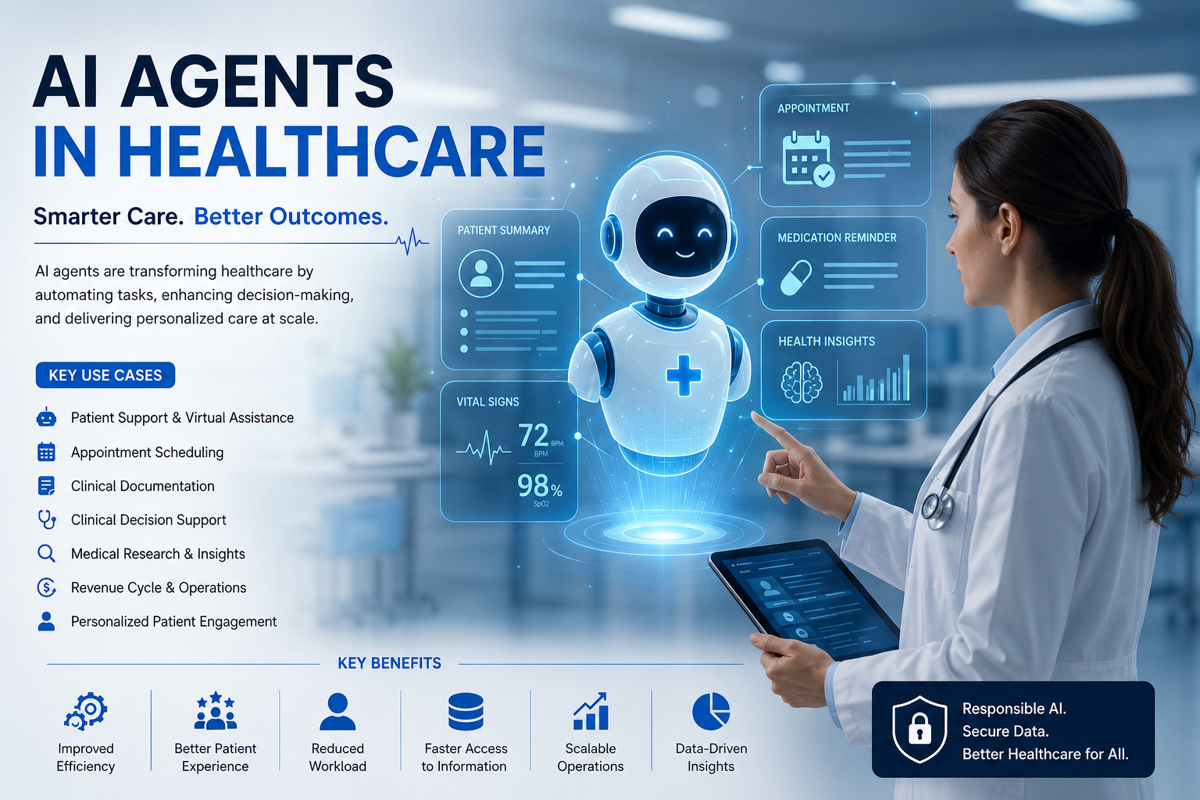
 AI Agents in Healthcare: Use Cases, Benefits, Challenges & Implementation Guide
Healthcare is becoming increasingly data-driven, connected, and patient-centric. As hospitals, clinics, insurers, and digital health companies manage growing volumes of medical information, there is a rising need for technology that can do more than simply provide automated responses.
This is where AI agents in healthcare are gaining attention.
Unlike conventional software or basic AI chatbots, AI agents can interpret information, reason through tasks, use connected tools, and take actions based on defined objectives. When implemented responsibly, they can support healthcare professionals, improve operational efficiency, and create more personalized patient experiences.
What Are AI Agents in Healthcare?
AI agents are intelligent software systems designed to perceive information, make decisions, and perform tasks with a certain degree of autonomy. In healthcare, an AI agent may interact with electronic health records (EHRs), scheduling systems, medical knowledge bases, laboratory systems, or patient communication platforms.
For example, instead of simply answering a patient's question about an appointment, an AI agent could identify the patient's request, check availability, recommend suitable slots, schedule the appointment, and send a confirmation.
The goal is not to replace healthcare professionals. Rather, healthcare AI agents are designed to handle repetitive or information-intensive workflows while allowing clinicians and staff to focus on activities requiring human judgment.
Key Use Cases of AI Agents in Healthcare
1. Patient Support and Virtual Assistance
AI agents can provide patients with round-the-clock assistance for routine questions, appointment information, preparation instructions, medication reminders, and administrative requests.
They can also personalize interactions by using relevant patient and appointment information, provided that appropriate privacy and access controls are in place.
2. Appointment Scheduling and Management
Scheduling is one of the most repetitive administrative activities in healthcare. AI agents can coordinate appointments by checking availability, matching patients with appropriate providers, handling rescheduling requests, and sending reminders.
This can reduce administrative workload while helping healthcare organizations improve scheduling efficiency.
3. Clinical Documentation
Healthcare professionals spend significant time documenting consultations and maintaining patient records. AI agents can assist with documentation by organizing information from consultations, generating structured drafts, summarizing relevant details, and preparing information for clinician review.
Human verification remains essential because clinical documentation can directly affect patient care.
4. Clinical Decision Support
AI agents can help clinicians organize and analyze large volumes of information, including patient history, laboratory results, imaging reports, and clinical guidelines.
Rather than making unsupervised medical decisions, an agent can surface relevant information, identify potential considerations, and present evidence for a qualified professional to evaluate.
5. Medical Research and Knowledge Discovery
Researchers often need to review large collections of scientific literature and clinical information. AI agents can assist with literature discovery, information extraction, comparison of findings, and research workflow automation.
This can accelerate knowledge-intensive tasks while keeping researchers responsible for validating conclusions.
6. Revenue Cycle and Administrative Operations
Healthcare organizations also face substantial administrative complexity. AI agents can assist with tasks such as claims processing, documentation checks, insurance-related workflows, billing inquiries, and patient communication.
Automating repetitive processes can help organizations reduce manual effort and improve operational consistency.
7. Personalized Patient Engagement
AI agents can support personalized engagement by delivering relevant reminders, educational information, follow-up communications, and care instructions.
For example, an agent could remind a patient about a scheduled follow-up and provide approved preparation information based on the patient's care pathway.
Benefits of AI Agents in Healthcare
Improved Operational Efficiency
AI agents can automate repetitive workflows and reduce the amount of manual coordination required from administrative teams. This allows employees to spend more time on complex tasks and direct patient interaction.
Better Patient Experience
Patients increasingly expect convenient digital services. Intelligent agents can provide faster responses, support self-service workflows, and make healthcare interactions more accessible outside conventional office hours.
Reduced Administrative Burden
Healthcare professionals frequently deal with documentation, scheduling, information retrieval, and other non-clinical responsibilities. AI agents can help streamline these processes and reduce unnecessary workload.
Faster Access to Information
Healthcare involves enormous amounts of information. AI agents can help retrieve, organize, and summarize relevant data, enabling professionals to access useful information more efficiently.
Scalable Healthcare Operations
Organizations can use AI agents to support large numbers of routine interactions without proportionally increasing administrative resources. This can be particularly valuable for healthcare providers managing growing patient volumes.
Challenges of Implementing AI Agents in Healthcare
The potential benefits are significant, but healthcare is a high-stakes environment. AI agent implementation therefore requires stronger safeguards than many conventional business applications.
Data Privacy and Security
Healthcare systems process highly sensitive information. AI agents must be designed around strict access controls, encryption, authentication, auditability, and appropriate data governance.
Organizations also need to understand where patient information is processed, stored, and transmitted.
Accuracy and Hallucinations
Generative AI systems can sometimes produce incorrect or unsupported information. In healthcare, even a seemingly minor error can have serious consequences.
AI agents should therefore operate within clearly defined boundaries, use reliable information sources where appropriate, and incorporate human review for high-impact decisions.
Regulatory Compliance
Healthcare organizations must consider applicable privacy, security, medical-device, and AI regulations in the jurisdictions where they operate.
Compliance should not be treated as a final-stage checklist. Regulatory requirements should influence the architecture, data flows, monitoring, and governance model from the beginning.
Integration With Existing Systems
Many healthcare organizations operate complex technology environments containing EHRs, laboratory systems, billing platforms, scheduling software, and other applications.
An AI agent must integrate securely with these systems without disrupting critical workflows. API-based integration, identity management, interoperability standards, and carefully controlled permissions are therefore important considerations.
Trust and Human Oversight
Healthcare professionals and patients need to understand when and how AI is being used. An effective implementation should provide transparency, clear escalation mechanisms, and human oversight where decisions carry significant clinical or operational consequences.
How to Implement AI Agents in Healthcare
A successful healthcare AI agent project should begin with the workflow rather than the technology.
Step 1: Identify a High-Value Use Case
Start with a specific, measurable problem. Appointment coordination, patient FAQs, documentation assistance, or administrative workflow automation may be more suitable starting points than highly autonomous clinical decision-making.
Step 2: Define the Agent's Scope
Clearly establish what the agent can and cannot do. Define permitted actions, data access, escalation conditions, and situations where human approval is mandatory.
Step 3: Prepare and Govern the Data
Assess data quality, availability, ownership, privacy requirements, and access permissions. Poor-quality or incomplete data can significantly reduce the reliability of an AI agent.
Step 4: Design the Agent Architecture
A healthcare AI agent may include a foundation model, retrieval system, memory layer, workflow engine, APIs, databases, security controls, monitoring tools, and a user interface.
The architecture should be designed around reliability, observability, scalability, and controlled access rather than autonomy alone.
Step 5: Integrate With Healthcare Systems
Connect the agent to relevant systems using secure APIs and interoperability mechanisms. Every integration should follow the principle of least privilege so that the agent receives only the access required for its assigned tasks.
Step 6: Establish Human-in-the-Loop Controls
Define workflows where healthcare professionals or authorized staff review, approve, or override agent-generated outputs.
Human oversight is especially important when an AI system influences diagnosis, treatment, medication, or other high-impact clinical decisions.
Step 7: Test Before Deployment
Testing should cover accuracy, security, privacy, reliability, bias, failure scenarios, unauthorized access, prompt manipulation, and unexpected inputs.
Healthcare AI systems should also be evaluated using realistic workflows rather than only generic benchmark tests.
Step 8: Monitor and Improve Continuously
Deployment is not the end of the process. Organizations should continuously monitor performance, errors, user feedback, security events, and changes in underlying models or data.
A strong governance framework should define how the agent is updated, audited, retrained, or temporarily disabled when necessary.
Best Practices for Healthcare AI Agents
Organizations can improve implementation outcomes by following several principles:
- Prioritize safety over autonomy: More autonomy is not automatically better.
- Keep humans involved: High-impact decisions should have appropriate professional oversight.
- Use reliable data sources: Ground AI responses in validated organizational or clinical information where appropriate.
- Apply least-privilege access: Limit what each agent can view and modify.
- Maintain audit trails: Record important actions, decisions, and system interactions.
- Design for explainability: Users should understand the basis and limitations of important outputs.
- Protect patient privacy: Build privacy and security into the architecture from the beginning.
- Start small and scale gradually: Validate one workflow before expanding across the organization.
The Future of AI Agents in Healthcare
The next phase of healthcare AI is likely to move beyond isolated assistants toward coordinated agent-based workflows. Multiple specialized agents could potentially collaborate across scheduling, documentation, research, patient engagement, and administrative operations while remaining subject to organizational policies and human oversight.
However, healthcare adoption will ultimately depend on more than technical capability. Reliability, clinical validation, interoperability, security, regulatory compliance, and user trust will determine whether AI agents can deliver sustainable value.
Conclusion
AI agents have the potential to reshape healthcare by combining intelligent reasoning with workflow automation and system integration. From patient support and appointment scheduling to clinical documentation, research, and administrative operations, their applications extend across the healthcare ecosystem.
The most successful implementations will not focus simply on creating the most autonomous AI system. Instead, they will focus on solving clearly defined problems, protecting sensitive data, integrating with existing infrastructure, maintaining human oversight, and continuously measuring performance.
For healthcare organizations, the opportunity lies in treating AI agents as governed digital collaborators-systems that augment human expertise while making everyday healthcare processes faster, more efficient, and more responsive.


Comments (1)
Leave a Comment
All Comments
Carlos Alves
Registered User 1 week, 5 days agoGreat article, Divisha! I particularly liked the emphasis on governance, data quality, and human oversight.
One thing I believe deserves even more attention is the integration challenge. Healthcare organizations often rely on multiple systems, each with different data structures, security requirements, and limitations. Making an AI agent work reliably across these systems can be just as challenging as building the AI itself.
Ultimately, I think the success of AI agents in healthcare will depend less on how autonomous they become and more on how well they integrate with existing processes while maintaining trust, security, and accountability.
Thanks for contributing to 2bInformed!